Comparison table
| Product | Price | Overall size | Fire bowl | Included accessories | Key spec |
|---|---|---|---|---|---|
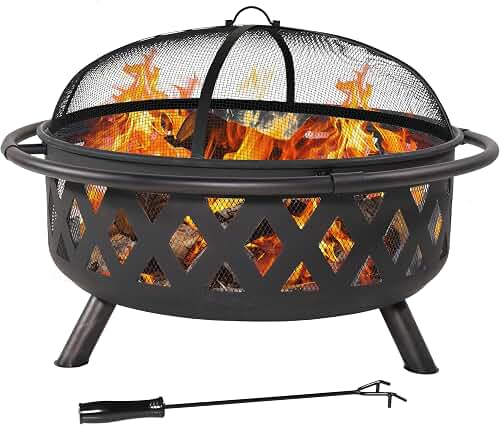
| Sunnydaze Crossweave 36" | Check price on Amazon | 36" dia × 24" H (16" H without screen) | 31" dia × 11" H | Spark screen, round cover, poker, wood grate | 24-gauge (0.6mm) steel; 23.8 lbs; seats 6–8 |
| OutVue 36 Inch | Check price on Amazon | 36" L × 36" W × 28" H | 24" W × 24" L × 10" H | Lid, poker, waterproof cover, 2 cooking grates | Holds 20 lb wood; table seats 6–8 |
| EcoNook 32 inch | Check price on Amazon | 32" table surface | 24" W × 4.6" deep, removable | Mesh lid, poker, wood grate (no BBQ grate) | Triangular leg reinforcements; table seats 4–6 |
| Quilushey 32 Inch | Check price on Amazon | 27" D × 23" W × 11" H | Not stated | Spark screen, fire poker | Powder-coated heavy-duty iron |
| BOINN 35 Inch Octagonal | Check price on Amazon | 19.7" × 19.7" × 17.1" | Not stated | Not stated | Claimed 90% less smoke; 5-min tool-free setup; 4–8 people |
| Fire Beauty | Check price on Amazon | Not stated | Not stated | Spark screen cover, log grate, poker | Heavy-duty iron, black coating |
Quick answer: For most backyards, the Sunnydaze Crossweave Large Outdoor Fire Pit, Wood Burning, Round, 36" is the safest default — 36 inches across, a spark screen, a cover, and an outer ring that keeps people off the hot bowl. If you want the fire pit to double as a patio table when it's not lit, the OutVue 36 Inch Fire Pit with 2 Grills is the more useful piece of furniture. And if you're spending under $50 to find out whether you'll actually use one, the Quilushey 32 Inch Fire Pit Table gets you there.
Fire pits are one of the few outdoor purchases where the cheap version genuinely works. A steel bowl holding burning wood is not complicated. What separates a $49 pit from a $179 one is bowl depth, steel thickness, how well the thing handles a season of rain, and whether it comes with the accessories you'd otherwise buy separately. Here's how these six compare on the specs the manufacturers actually publish.
Sunnydaze Crossweave Large Outdoor Fire Pit — Best Overall
At $179.10 this is the priciest option here, and it's the one with the most specific published numbers behind it. The Sunnydaze Crossweave Large Outdoor Fire Pit, Wood Burning, Round, 36" measures 36" in diameter by 24" high overall, with a fire bowl of 31" diameter by 11" high, and weighs 23.8 lbs. Sunnydaze lists it as 24-gauge (0.6mm) steel with black high-temperature paint.
The best best fire pits backyard for your situation depends on how you plan to use it and where.
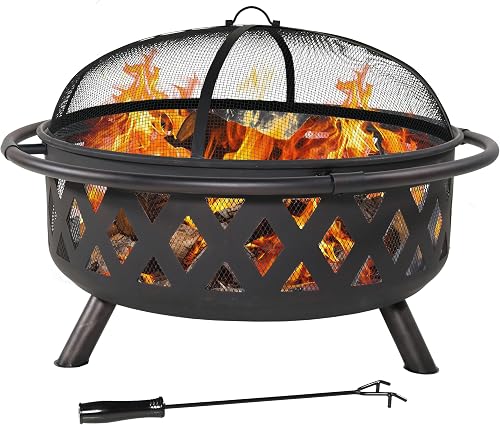
The detail I'd actually pay for is the outer ring. It's a physical barrier that keeps people a step back from the flames, and it doubles as a handle for repositioning the pit. On a deck or a patio where kids and dogs circulate, that's a real safety feature rather than a styling one.
It ships with a spark screen, a weather-resistant round cover, a poker, and a wood-burning grate. Mesh-covered cutouts and the crossweave pattern feed airflow, which Sunnydaze credits for steadier burns with less smoke. Assembly is three legs plus the outer rim. Sunnydaze is explicit that you should set it on stone, brick, gravel, or a fire-safe pad — worth noting if your plan involves a wood deck.
Sized for 6–8 people. If you're buying one fire pit and keeping it, this is it.
OutVue 36 Inch Fire Pit with 2 Grills — Best for Cooking and Double Duty
The OutVue 36 Inch Fire Pit with 2 Grills at $104.21 is the most genuinely multi-purpose unit here, and it's the only one whose "3-in-1" claim involves hardware you'd actually use.
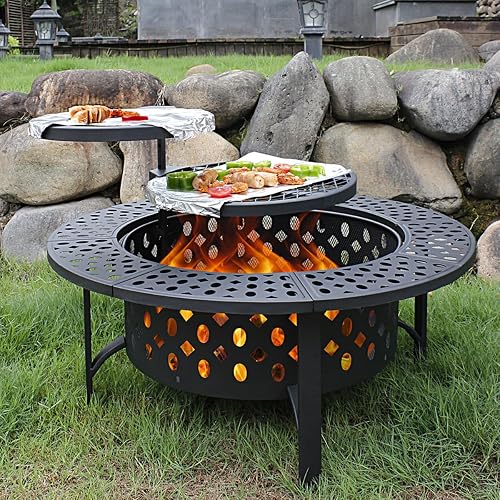
Two cooking grills, both height-adjustable and 360° swivel, and both removable. You can move food off direct heat, hold it warm, or set a pan on them. That's a meaningful step above a fixed grate. Cover the bowl with the lid and add the tabletop and you get a 36" round table OutVue rates for 6–8 people — so it isn't a dead object between fires.
Overall footprint is 36" L × 36" W × 28" H, with a fire bowl of 24" × 24" × 10" H, holding up to 20 lb of wood. Four legs plus the unit's weight are meant to stabilize it on uneven ground. Powder-coated for rust resistance, with screen mesh on the vents and a geometric cut-out design on the sides that throws firelight shadows.
The box includes the pit, lid, poker, waterproof cover, and both grates. OutVue says 20 minutes to assemble and — this is a useful tip — advises leaving screws loose until every piece is connected. Believe them; sheet metal parts almost never line up otherwise.
EcoNook 32 inch Fire Pit — Best for a Deeper Bowl on a Budget
At $64.99, the EcoNook 32 inch Fire Pit leads with bowl geometry, which is the right thing to lead with. The bowl is 4.6" deep and 24" wide, and EcoNook's pitch is straightforward: more wood, longer burns.
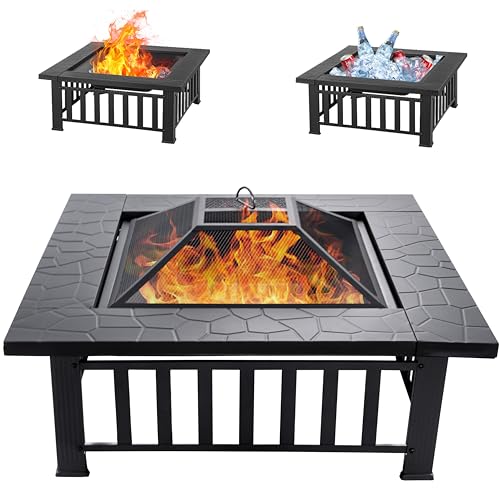
Better still, the bowl is removable. That makes drainage and ash cleanup far less miserable than tipping over an entire welded pit, and it keeps debris contained while you're using it. Anyone who's tried to empty a fixed fire bowl after a rainstorm knows why this matters.
The frame is described as thicker iron with triangular metal plates reinforcing each leg top and bottom. The surface carries a stone-pattern finish — a bit more visual interest than plain black if your patio leans decorative. Lid off, it works as a 32" table for 4–6 people, which EcoNook notes is larger than typical.
You get the pit, a mesh lid, a poker, and a wood grate. Read the spec sheet carefully on this one: EcoNook says the BBQ grate is not included, despite the "3-in-1" framing covering BBQ use. If grilling matters to you, the OutVue is the honest choice.
Quilushey 32 Inch Fire Pit Table — Best Budget Pick
$48.98 is the entry point, and the Quilushey 32 Inch Fire Pit Table with Fire Poker & Spark Screen doesn't skip the two accessories that matter most: a spark screen mesh cover and a fire poker both come in the box.
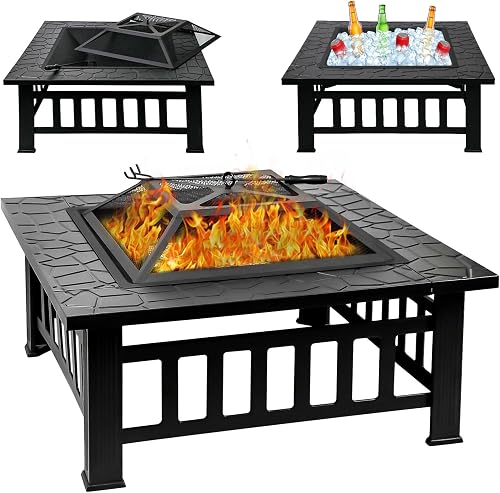
It's built from heavy-duty iron with a powder-coated black finish, and Quilushey lists the dimensions as 27" deep × 23" wide × 11" high. Note that those numbers are noticeably smaller than the "32 inch" in the title — worth squaring against your space before you order, since the listing describes both. Beyond wood burning, it's positioned as a BBQ grill or an ice bucket cooler.
This is the buy-it-and-see option. If you're not sure you'll use a fire pit more than three times a year, spending under $50 to find out is a reasonable bet, and you're not out much if the answer is no.
BOINN 35 Inch Octagonal Outdoor Fire Pit — Best for Camping and Portability
The BOINN 35 Inch Octagonal Outdoor Fire Pit at $89.99 is built around a different priority: getting the fire pit somewhere else. The modular design clicks together in under 5 minutes with no tools, and BOINN says it packs into a car trunk, RV storage, or a balcony corner.
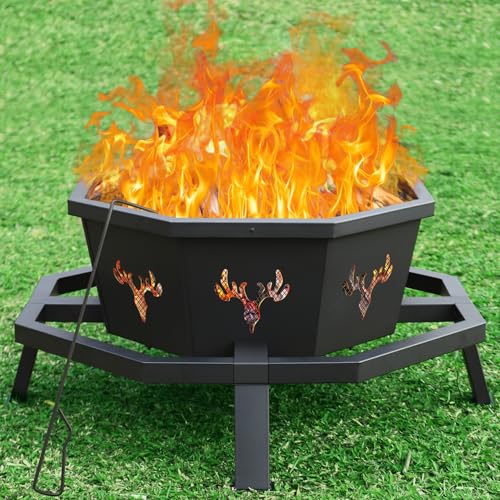
The published footprint is 19.7" × 19.7" × 17.1", which is compact relative to the 35" figure in the title — again, check the numbers against your expectations. BOINN rates it for gatherings of 4–8 people.
BOINN makes two headline performance claims: a convection heat system and precision-engineered burning chamber that cut smoke by 90%, and an enhanced combustion system that improves efficiency 80% over traditional fire pits. Those are the manufacturer's figures, not independently verified ones, so treat them as claims rather than measurements — but the underlying design principle (secondary combustion in a double-wall chamber) is a real thing that real products do. Materials are described as premium and weatherproof, and it carries a 1-year quality guarantee with exchanges.
Fire Beauty Fire Pit for Outside Wood Burning — Best for Small Patios and Beach Trips
The Fire Beauty Fire Pit for Outside Wood Burning is $64.99 and unapologetically compact. Fire Beauty describes it as small, light, and easy to carry — designed to be "not too large, but just right for good burning."
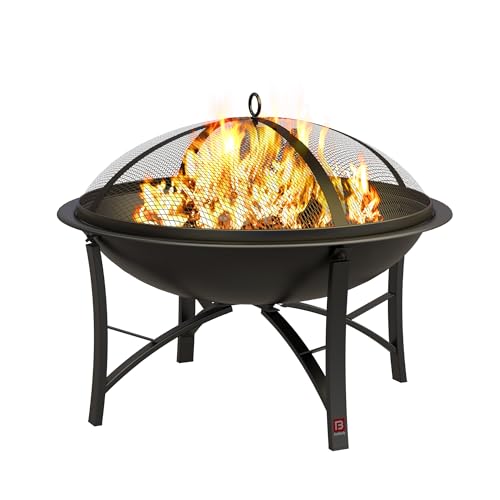
Construction is heavy-duty iron with a black coating. The kit includes a spark screen cover, a log grate, and a poker, so the safety basics are covered. The design is described as sleek and contemporary rather than rustic.
Fire Beauty is upfront that this is aimed at porches, patios, gardens, poolsides, camping, and the beach. If your outdoor space is a small townhouse patio or a condo balcony where a 36" pit would dominate, the smaller footprint is the point. It's also the pick if you want something you can throw in the car without disassembly.
One caveat: Fire Beauty publishes no specific dimensions, bowl depth, or weight in the listing data. That's a real gap when you're trying to plan clearances.
How to choose
Start with bowl depth, not overall width. The "36-inch fire pit" headline usually describes the outer frame or tabletop, not the fire. EcoNook publishes a 4.6" bowl depth; Sunnydaze publishes an 11" bowl; OutVue publishes 10". A deeper bowl holds more wood, burns longer between reloads, and contains embers better. Where depth isn't stated, you're buying blind.
Decide whether you want a fire pit or a piece of furniture. OutVue and EcoNook both convert to tables. That's genuinely useful on a small patio where a permanently-lit-or-dead 36" object is a waste of space. Sunnydaze and Fire Beauty don't convert — they're fire pits, full stop.
If you want to cook, check what's in the box. OutVue includes two adjustable swivel grills. EcoNook explicitly does not include a BBQ grate. Several listings say "BBQ" in the title without shipping grilling hardware. Read the accessory list, not the title.
Match size to your gathering, not your ambition. Sunnydaze and OutVue are rated 6–8. BOINN is rated 4–8. EcoNook's table seats 4–6. Fire Beauty is explicitly compact. Buying larger than you need means more wood per fire and a harder object to store.
Surface matters more than people expect. Sunnydaze is specific about placing the pit on stone, brick, gravel, or a fire-safe pad. That guidance applies to every wood-burning pit here. If you're on a composite or wood deck, budget for a fire-resistant pad on top of whatever you spend on the pit itself, and check your HOA and local ordinances before you light anything.
Cover included or not. Sunnydaze and OutVue both ship weather-resistant covers. The others don't list one. A cover is the cheapest thing you can do to keep a steel bowl from rusting, and buying one separately eats into any price savings.
Assembly reality check. BOINN claims tool-free setup in under 5 minutes. OutVue says 20 minutes and advises leaving screws loose until everything's connected. Sunnydaze is three legs and a rim. None of these are hard, but the modular BOINN is the only one that packs back down easily.
FAQ
Are any of these safe on a wood or composite deck? Treat none of them as deck-safe out of the box. Sunnydaze specifically directs you to place its pit on stone, brick, gravel, or a fire-safe pad. Every wood-burning pit here radiates heat downward and throws embers. If you're on a deck, use a fire-resistant pad and check your local fire code — many jurisdictions restrict open wood fires on elevated wood structures.
Which one produces the least smoke? BOINN claims a 90% smoke reduction from its convection heat system and precision-engineered burning chamber, which is the most aggressive claim in this group. Sunnydaze credits its airflow cutouts and wood-burning grate for steadier burns with less smoke. Both are manufacturer statements rather than tested figures. Dry, seasoned hardwood does more for smoke than any design feature.
Do these work as grills? OutVue is the clearest yes — two height-adjustable, 360° swivel grills that you can also set a pan on. Quilushey and Fire Beauty describe BBQ use, and Fire Beauty includes a log grate. EcoNook describes BBQ use but states plainly that the BBQ grate is not included. If grilling is a primary use, OutVue is the one with the hardware.
Is the $179 Sunnydaze worth it over the $49 Quilushey? It depends on how often you'll light it. Sunnydaze publishes far more spec detail — 24-gauge steel, a 31" × 11" bowl, 23.8 lbs — and ships a cover plus the outer safety ring. The Quilushey ships a spark screen and poker for under $50. If you're testing whether you'll use a fire pit at all, start cheap. If you already know you'll use it weekly through the fall, buy the one with published steel gauge and a cover. On any of these, go read the current buyer reviews before you order — reviews are where seam quality and rust-after-one-season problems surface, and no spec sheet will tell you that.
Related guides
- Aluminum vs Teak vs Wicker Patio Furniture
- How to Succeed with Best patio and outdoor living furniture - patio sets, outdoor umbrellas, fire pits, adirondack chairs, pergolas, hammocks, gazebos, outdoor sofas, outdoor dining sets
- Privacy Policy
Key Takeaways
- Choosing the right best fire pits backyard means matching the key features to your specific needs and budget
- Read real customer reviews and check the return policy before you commit
- Compare value across models — the priciest option is not always the best fit