Specifications at a glance
| Product | Fuel | Size | Heat output | Spark control | Price |
|---|---|---|---|---|---|
| OutVue 36 Inch Fire Pit with 2 Grills | Wood (holds up to 20 lb) | 36" L x 36" W x 28" H; bowl 24" x 24" x 10" | Not stated | Screen meshes on the vents | Check price on Amazon |
| OutVue 42 Inch Fire Pit with 2 Grills | Wood (holds up to 30 lb) | 42" round tabletop | Not stated | Screen meshes on the vents | Check price on Amazon |
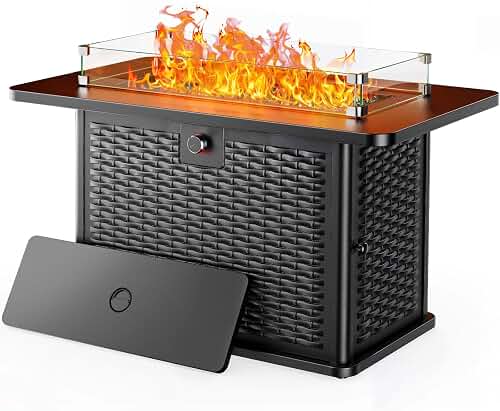
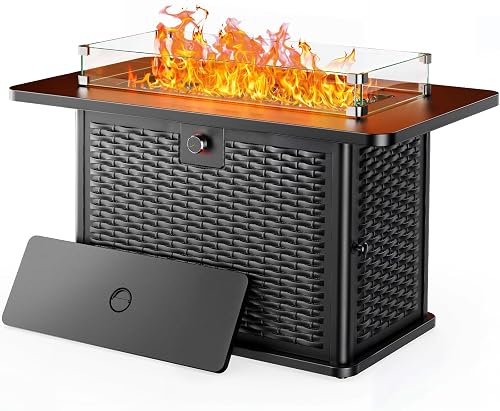
| Ciays 43-Inch Rectangular Propane Fire Pit | Propane | 43" rectangular | 60,000 BTU | Wind guard (no embers — gas) | Check price on Amazon |
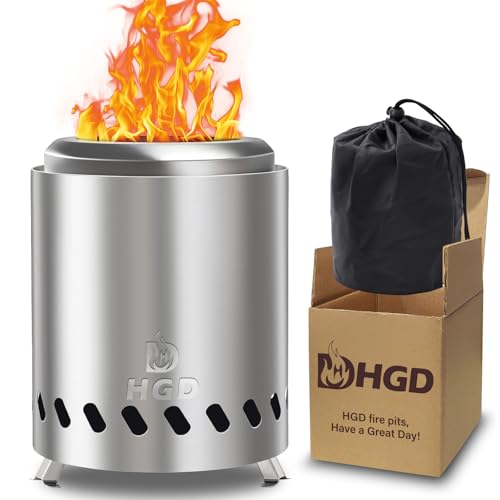
| HGD Tabletop Fire Pit | Wood or pellets | Tabletop / mini | Not stated | Not stated | Check price on Amazon |
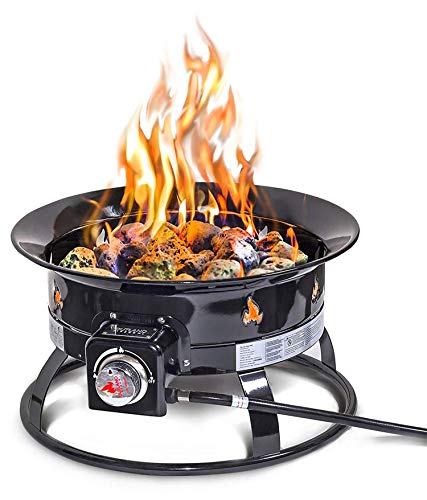
| Outland Living Portable Propane Fire Pit 893 Deluxe | Propane | 19" L x 19" W x 11" H | 58,000 BTU | Spark free; CSA approved | Check price on Amazon |
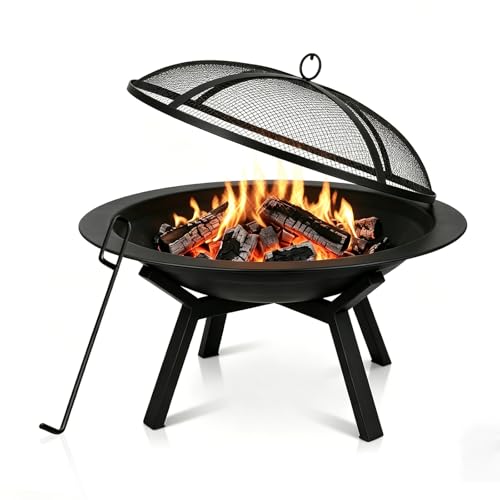
| Outdoor Wood Burning Fire Pit (IBGUC) | Wood | 28" diameter bowl | Not stated | Tight-mesh spark screen + hook | Check price on Amazon |
Quick answer: Keep any fire pit at least 10 feet from your house, fences, and overhanging branches, put it on a non-combustible surface (never bare wood decking or dry grass), and never leave it burning unattended. On a wood or composite deck, a propane fire pit on a fire-resistant mat is the far safer choice than a wood burner, because there are no flying embers to land in the gaps between boards.
Most fire pit accidents are boring and preventable: a spark in a deck gap, a tipped-over bowl on soft ground, a propane hose left connected in a sealed storage box. The rest of this guide covers the rules that actually matter, and which of the fire pits below fit which situation.
The rules that actually matter
Clearance. Ten feet from structures is the common municipal minimum, and 15 is better. Look up too — a pergola roof, a low branch, or a fabric umbrella above a fire pit is the single most-missed hazard.
The best how to use fire pit safely for your situation depends on how you plan to use it and where.
Surface. Wood burners belong on stone, concrete, pavers, gravel, sand, or dirt. Not composite decking, which softens and scars under radiant heat. If you must use a deck, use a propane unit plus a fire-resistant mat, and check whether your HOA or lease bans open flame entirely.
Stability. A pit that rocks is a pit that spills. Adjustable feet or reinforced legs matter more on lawns and older patios than any other feature.
Wind. If it's gusty enough to move patio cushions, don't light a wood fire. Embers travel much further than people expect.
Extinguishing. Wood fires need water and stirring until the ash is cool to a bare hand held above it — not "it looks out." Propane needs the knob closed and the tank valve closed. Ash stays hot for 24 hours; it goes in a metal can outdoors, never a plastic bin or a garage.
Kids and pets. A three-foot no-go ring, enforced by an adult who isn't also drinking. Metal fire pit walls stay hot long after the flames are gone.
Propane fire pit safety specifically
Propane removes the ember problem but adds a gas problem. The rules:
- Store and use the tank outdoors and upright, never in a garage, shed, or under a sealed bench.
- Route the hose so nobody trips on it and it can't touch a hot surface. The Outland Living Portable Propane Fire Pit's pre-attached 10-ft hose is designed to keep a standard 20-lb tank out of sight while staying outside the heat zone.
- Soapy-water test the connection each season. Bubbles mean stop.
- Light with the lid off. Never light with a cover on, and never place a cover on a fire pit that is still warm.
- Turn off the tank valve first, then the burner knob, so residual gas in the line burns off.
- CSA approval matters if you camp — the Outland Living Portable Propane Fire Pit is CSA approved and the listing notes it is safe to use during most campfire bans, though you should always confirm your local restrictions yourself.
Who this kind of setup is for
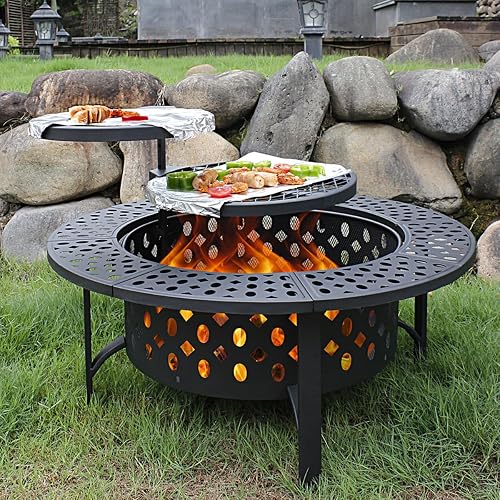
A wood-burning pit with a proper spark screen suits you if you have a masonry patio, a gravel pad, or open lawn with real clearance; you like the smell and crackle; and you're willing to handle ash, storage, and a slow cool-down. If you also want to cook, the 3-in-1 designs from OutVue add adjustable swivel grills and a lid that converts the pit into a table.
A propane pit suits you if you're on a deck or balcony, if your area has burn bans, if you want heat within 30 seconds and off within 30 seconds, or if you have kids and want no ember risk at all.
Who should skip a fire pit entirely
Skip it if your only outdoor space is a covered balcony, a screened porch, or anywhere with a ceiling — no fire pit, gas or wood, is safe under a roof. Skip it if you can't achieve 10 feet of clearance from siding or a fence. Skip a wood burner if you live somewhere with regular red-flag fire conditions, if smoke will drift into a neighbor's open window, or if you don't have a safe place to store hot ash. And skip the whole category if realistically nobody will be sober and awake to supervise until the fire is fully out.
Honest trade-offs
Wood is cheaper up front and gives you real flame, but you get smoke, ash, ember risk, and a 45-minute cool-down. Propane costs more, gives less dramatic flame, and ties you to a tank — but it's the only option most decks and campgrounds will tolerate.
Combination fire-pit tables are genuinely useful for small patios, but the tabletop is not a heat-free surface. Give the metal time to cool before treating it as a table, and don't set the lid on a pit that isn't out.
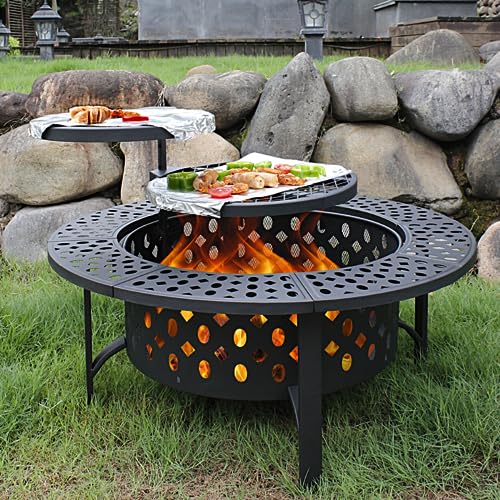
Bigger isn't safer. The OutVue 42-inch holds up to 30 lb of wood versus 20 lb on the 36-inch — that's more heat, more embers, and a bigger required clearance ring, not just more warmth.
What to check on the listing before you buy
Listings change, so verify these yourself at the moment you order:
- Current price — all prices above move, sometimes weekly.
- Variant — size, color and finish options can share one listing page; confirm the diameter and the fuel type you're selecting.
- What's actually in the box — the OutVue 36 Inch model lists a round waterproof cover; the 42-inch listing explicitly says no waterproof cover. Propane tanks are almost never included.
- Spark screen included or extra — critical for any wood burner.
- Warranty and replacement parts — both OutVue listings mention replacement parts availability; confirm current terms.
- Certification — look for CSA or similar on gas units.
- Owner reviews — read recent ones yourself, filtering for comments about stability, rust after a season, and burner performance.
Consider instead if…
Ciays 43-Inch Rectangular Propane Fire Pit with 60,000 BTU Output, Fire Pit Table Premium Gas for Outside Patio with 304 Stainless Steel H-Burner, Glass Stones, and Wind Guard,Black — consider instead if…
…your fire pit lives on a deck and doubles as the dinner table. It's a 60,000 BTU propane unit with a 304 stainless H-burner, a transparent wind guard to steady the flame in a breeze, an infinite flame-adjustment knob, adjustable feet for uneven patios, and a cover that turns it into a regular table when the fire is off. The extra 3-inch table edge gives you somewhere to put drinks that isn't next to the burner.
Outland Living Portable Propane Fire Pit, 19-inch, 58,000 BTU with Fire Pit Cover & Carry Kit, Smokeless Gas Firebowl | Perfect for Camping, Patio, Backyard, Tailgating, Deck, RV| Black 893 Deluxe — consider instead if…
…you need something that travels and complies. It's CSA approved, spark free, 58,000 BTU, 19" x 19" x 11", sets up in minutes with no tools, and ships with a cover and carry kit, a 10-ft pre-attached hose for a standard 20-lb tank (not included), an adjustable regulator, and a 4.4-lb lava rock set.
Outdoor Wood Burning Fire Pit, Heavy Duty Round Steel Fire Bowl for Backyard, Patio, Camping, Bonfire, Black Finish, with Mesh Spark Screen and Hook — consider instead if…
…you want real wood fire with the safety gear included. The 28-inch steel bowl comes with a tight-mesh spark screen and a 20.5-inch poker whose hook is designed to lift the hot screen from a distance — exactly the tool most people improvise badly. Reinforced legs give a wobble-free stance on grass, sand, or gravel, and assembly is tool-free.
HGD Tabletop Fire Pit, Smokeless Firepit Outdoor, Mini Fire Pit for with Carry Bag for Camping Backyard Patio Garden Picnic, Silver — consider instead if…
…you want s'mores on a small balcony without a full-size fire. It's a stainless steel double-wall design with vent holes intended to reduce smoke, burns wood or pellets, has a removable ash grate, and packs into a carry bag. Small flame still means real fire — it needs a non-combustible surface under it.
OutVue 42 Inch Fire Pit with 2 Grills, Extra Large Wood Burning Fire Pits for Outside with Lid & Poker, Heavy Duty Firepit,BBQ& Outdoor Firepit & Round Metal Table 3 in 1 for Patio, Picnic, Party — consider instead if…
…you host 8-10 people and have the clearance for a bigger fire. It holds up to 30 lb of wood, has vent screen meshes to limit flying embers, two height-adjustable 360° swivel grills, four legs for stability on uneven ground, and a high-temperature powder coat. Note the listing states no waterproof cover is included.
OutVue 36 Inch Fire Pit with 2 Grills, Wood Burning Fire Pits for Outside with Lid, Poker and Round Waterproof Cover, BBQ& Outdoor Firepit & Round Metal Table 3 in 1 for Patio, Picnic, Party — consider instead if…
…you want the same 3-in-1 idea in a smaller footprint with rain protection included. It holds up to 20 lb of wood, seats 6-8 as a table with the lid on, and ships with a round waterproof cover, a poker, two grates, and a lid. Overall 36" x 36" x 28", with a 24" x 24" x 10" fire bowl.
FAQ
Can I put a fire pit on a wood or composite deck? Only a propane unit, only on a fire-resistant mat or pavers, and only if your local code, HOA, or lease allows it. Wood burners drop embers that fall straight into board gaps where you can't see them smolder.
How far should a fire pit be from the house? Ten feet minimum from any structure, fence, or combustible material, with nothing overhanging. Larger fires — like a 30-lb wood load — want more.
Do I still need a spark screen if the pit has vent mesh? Yes. Vent screens limit embers escaping sideways through the airflow holes; a top-mounted spark screen is what stops embers rising out of the open bowl.
Is a propane fire pit safe during a burn ban? Often, but not always. The Outland Living Portable Propane Fire Pit's listing notes it is CSA approved and safe during most campfire bans — always confirm current restrictions with your local fire authority before lighting anything.
Related guides
- How TerraceHaus Researches Products
- Current Rates for Best patio and outdoor living furniture - patio sets, outdoor umbrellas, fire pits, adirondack chairs, pergolas, hammocks, gazebos, outdoor sofas, outdoor dining sets
- Best patio and outdoor living furniture - patio sets, outdoor umbrellas, fire pits, adirondack chairs, pergolas, hammocks, gazebos, outdoor sofas, outdoor dining sets Requirements Explained
Key Takeaways
- Choosing the right how to use fire pit safely means matching the key features to your specific needs and budget
- Read real customer reviews and check the return policy before you commit
- Compare value across models — the priciest option is not always the best fit