Comparison table
| Product | Price | Size | Frame | Roof | Wind rating | Snow rating |
|---|---|---|---|---|---|---|
| Aoxun 10' x 12' Outdoor Wood Gazebo | Check price on Amazon | 12' L x 10' W | Cedar wood, 4"x4" posts | Galvanized steel double roof | 47–54 mph (bolted) | 15 in depth |
| Breezestival 10x12FT Hardtop Gazebo | Check price on Amazon | 10 x 12 ft | Powder-coated galvanized steel | Galvanized steel double roof | 38 mph / Grade 7 | Not stated |
| Jocisland 20' x 20' Cedar Wood Gazebo | Check price on Amazon | 20 x 20 ft | Cedar wood, 9 posts | Galvanized steel sloped | 100 mph | Not stated (20,800 lbs support) |
| Aoxun 8'x10' Aluminum & Polycarbonate | Check price on Amazon | 8 x 10 ft | Aluminum | Multi-wall polycarbonate | 38 mph | 6 in |
| Aoxun 8'x5' Premium Aluminum & Polycarbonate | Check price on Amazon | 8 x 5 ft | Aluminum | Multi-wall polycarbonate | 40 mph | 6 in |
| Aoxun 8'x10' Gazebo Pergola, Sloped Roof | Check price on Amazon | 8 x 10 ft | Not stated | Polycarbonate hollow sheet | Not stated | Not stated (55 lbs/㎡) |
Quick answer: If you want a proper permanent structure with a wood frame and a metal roof, the Aoxun 10' x 12' Outdoor Wood Gazebo hits the best balance of size, materials and price. If you're on a budget or working with a small patio against the house, a wall-mounted aluminum pergola like the Aoxun 8'x10' Gazebo with Aluminum Frame & Polycarbonate Panel does the shade job for a fraction of the cost. And if you're covering a genuinely large gathering space, the Jocisland 20' x 20' Cedar Wood Gazebo is the only one here built at that scale.
Gazebos and pergolas get lumped together in listings, but they solve different problems. A hardtop gazebo is a freestanding roofed room — you anchor it, you furnish it, you use it in the rain. A wall-mounted polycarbonate pergola is really a hard awning: it shades a door, a grill, or a hot tub, and it costs a quarter as much. Figure out which one you're actually shopping for before you compare prices, because the price gap between them is enormous and it's not a quality gap.
Below are six options across both categories, from $209 to $2,799.
The best best gazebos pergolas for your situation depends on how you plan to use it and where.
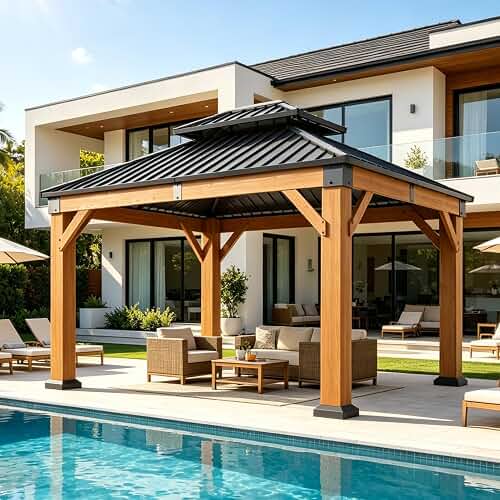
Aoxun 10' x 12' Outdoor Wood Gazebo — Best Overall
This is the one to look at first if you want a real gazebo and not an awning. The frame uses widened 4"x4" cedar wood posts, which is what gives it the look most people picture when they say "gazebo" — timber, not painted steel tube. The roof is galvanized steel in a double-roof configuration, which vents hot air out the top gap and sheds rain and snow down the slope.
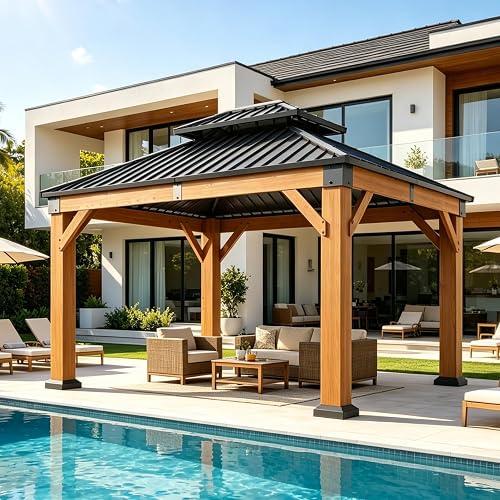
The published weather numbers are the useful part: 15 inches of snow loading depth and wind resistance rated at 47–54 mph once you've installed the expansion bolts. That bolt caveat matters — the rating assumes it's anchored, not just set down on pavers. At 12' L x 10' W it's sized for a table and chairs with room to walk around, and there are ceiling hooks rated to 44 lbs so you can hang a fan, a light, or a patio heater without improvising a mount.
At $847.86 it sits well below the big cedar structures and well above the aluminum awnings, which is roughly where most people's actual needs land.
Breezestival 10x12FT Hardtop Gazebo Brown — Best for Bugs and Privacy
Same 10x12 footprint as the Aoxun, but the frame is powder-coated galvanized steel with triangular reinforcements rather than wood, and it comes in at $539.99. If the cedar look isn't a priority, that's a meaningful saving.
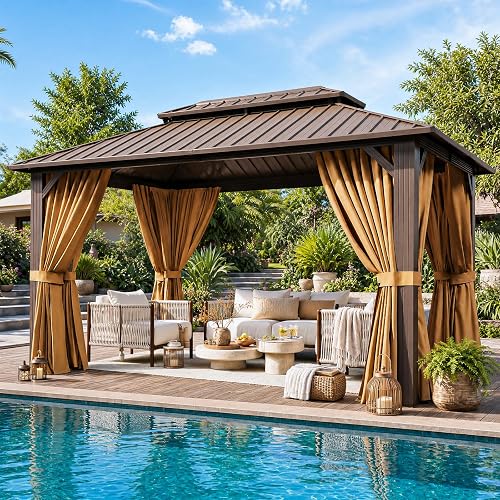
What you get here that the wood gazebo doesn't include: mesh netting on all four sides for insect-free 360° visibility, plus zippered thermal curtains for privacy and warmth. That combination is the difference between a structure you use at dusk in July and one you abandon to the mosquitoes. The galvanized steel double roof is stated to block 99% of UV rays.
Wind resistance is listed at 38 mph with Grade 7 wind resistance from the pre-drilled legs plus included bolts and stakes — lower than the cedar model above, so this is a better fit for a sheltered yard than an exposed hilltop. Budget a real afternoon for assembly: the listing says under 6 hours with 3–4 people, and it ships in separate packages, so don't plan the build until every box has landed.
Breezestival 10x12FT Hardtop Gazebo Brown — $539.99
Jocisland 20' x 20' Cedar Wood Gazebo — Best for Large Gatherings
This is a different class of purchase. At 20' x 20' the interior is stated to fit 20–40 people, and the structure is built to match: nine heavy-duty wooden posts anchored with expansion bolts, powder-coated steel bolts and brackets, a solid cedar frame and a rust-resistant galvanized steel sloped roof.
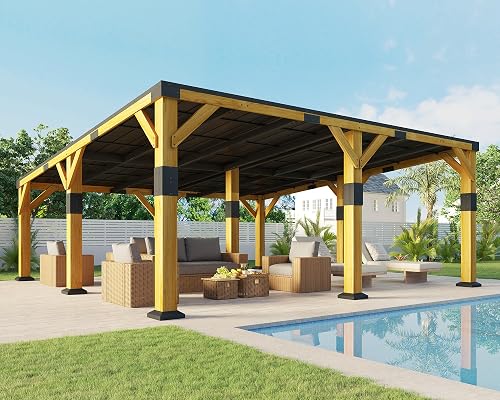
The engineering figures are the headline — wind resistance up to 100 mph and support for 20,800 lbs. That's carport territory, and the listing does say it doubles as one. It anchors to concrete or decking, and Jocisland recommends building a 21x21 ft concrete or wooden foundation first. Factor that into your budget and your calendar, because it's not optional prep. Assembly itself is described as basic-tools work — a drill and a ladder — with a step-by-step guide.
At $2,799.99 plus a foundation, this only makes sense if you genuinely need the span. If you're covering a six-person dining table, buy one of the 10x12s and spend the difference on furniture.
Jocisland 20' x 20' Cedar Wood Gazebo with Sloped Galvanized Steel Roof — $2,799.99
Aoxun 8'x10' Gazebo with Aluminum Frame & Polycarbonate Panel — Best Budget Pergola
At $269.99 this is a wall-mounted aluminum pergola with multi-walled polycarbonate roof panels, and it's the smart pick if what you actually need is shade over a back door, a grill station or a small seating area.
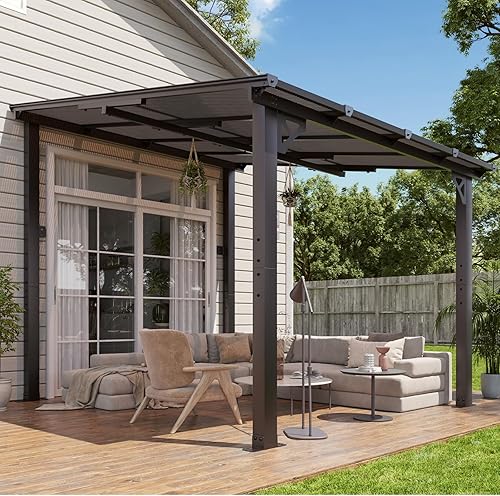
The panels block 99% of UV rays and reduce solar heat gain by up to 80% while still passing 92% light transmission, so the space underneath stays bright rather than cave-dark — a real advantage over a solid roof if the pergola sits next to a window. Load capacity is 55 lbs/㎡, wind resistance up to 38 mph, and it carries up to 6 inches of snow. The material is rated from -40°F to 240°F.
Read the installation note carefully: Aoxun recommends fixing it to a wall with the supplied expansion bolts for stability, and the stated ratings assume you did. This is not a freestanding structure for the middle of a lawn.
Aoxun 8'x10' Gazebo with Aluminum Frame & Polycarbonate Panel, Black — $269.99
Aoxun 8'x5' Premium Gazebo with Aluminum Frame & Polycarbonate Panel — Best for Doorways and Tight Patios
The narrowest option here at 8' x 5', and the cheapest at $209.99. Think entryway cover, side-door shelter, or a shaded strip along a townhouse patio where a 10-footer simply doesn't fit.
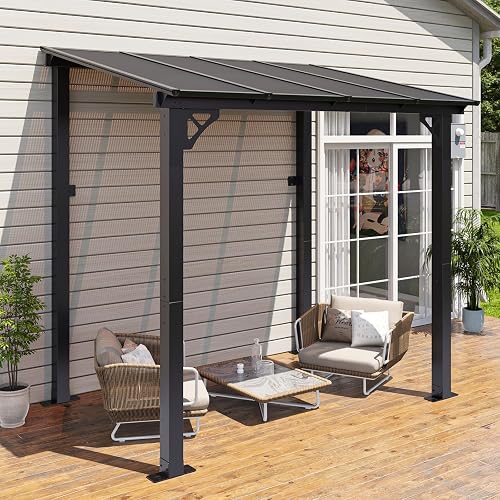
Despite the smaller footprint, the stated specs are the strongest of the three aluminum pergolas: wind resistance up to 40 mph, 6 inches of snow, 55 lbs/㎡ load-bearing, and heat gain reduction up to 90% — higher than the 8'x10' model's 80%, with the same 99% UV block and 92% light transmission. The sloped roof channels rainwater off rather than letting it pool.
It ships with labelled components, a 1-year warranty, and the same wall-mount recommendation using the provided expansion bolts.
Aoxun 8'x5' Premium Gazebo with Aluminum Frame & Polycarbonate Panel, Black — $209.99
Aoxun 8'x10' Gazebo for Patio, Gazebo Pergola with Sloped Roof — Best for Hot Tubs and Poolside
Closely related to the other 8'x10' Aoxun, at $249.99, and specifically pitched by the maker for use near a pool, a hot tub, or as a covered entertainment area.
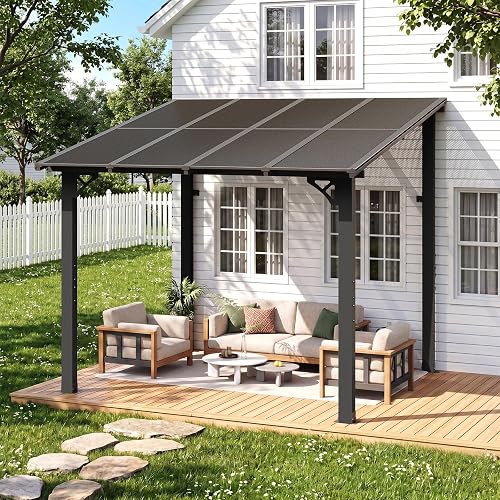
The roof is a durable polycarbonate hollow sheet that provides shade from sun and rain while retaining heat and passing light — the heat-retention angle is the reason the poolside and hot-tub use case comes up. Load-bearing is the same 55 lbs/㎡ as its sibling, rated to endure heavy snow or rain, and again the rating depends on fastening it securely to both wall and ground. There's a one-year warranty, illustrated instructions and numbered parts.
Between this and the 8'x10' polycarbonate-panel model above, the deciding factor is $20 and whether you want the more detailed published panel specs or the poolside-oriented design.
Aoxun 8'x10' Gazebo for Patio, Gazebo Pergola with Sloped Roof, Black — $249.99
How to choose
Freestanding or wall-mounted. This is the first fork and it decides everything else. The two 10x12 hardtops and the Jocisland are freestanding structures. All three Aoxun polycarbonate models are explicitly recommended to be fixed to a wall as well as the ground. If there's no wall where you want shade, the aluminum pergolas are off the table regardless of price.
Material. Cedar frames look warmer and read as architecture; galvanized steel frames cost less and don't need finishing. For roofs, galvanized steel is opaque and shed-like; multi-wall polycarbonate passes light — the Aoxun panels are stated at 92% transmission — so the space underneath stays bright. If you want a dark, cool retreat, go metal roof. If the structure sits next to a window you don't want to darken, go polycarbonate.
Concrete patios specifically. Every product here anchors with expansion bolts, which is exactly what you want on a concrete slab — you drill, you sleeve, you bolt. The Jocisland explicitly states it stays firmly in place on concrete or decking, and recommends a 21x21 ft foundation. The published wind ratings on all of these assume the anchors are in. An unanchored gazebo on a slab is a sail.
Size. Gazebos here run 8'x5' at the small end to 20'x20' at the large. The practical middle is 10x12, which fits a dining set. Measure your slab, then subtract — you want walking room outside the posts, not posts at the slab edge.
Assembly reality. The Breezestival lists under 6 hours with 3–4 people and ships in multiple boxes. The Jocisland needs a poured or built foundation first. The aluminum pergolas are the only ones that read as a straightforward afternoon. Plan accordingly.
Check the reviews yourself. Before you buy any of these, read through the recent customer reviews on the product page — particularly anything about missing hardware, packaging damage or instruction quality, which are the failure modes that actually ruin a gazebo weekend.
FAQ
What's the best material for a gazebo? For the frame, cedar and powder-coated galvanized steel are both sound choices — cedar for looks, steel for cost and zero finishing. For the roof, galvanized steel gives you full shade and sheds snow; multi-wall polycarbonate gives you UV protection with light still coming through. There's no single winner, only a match to what you want the space to feel like.
What sizes do gazebos come in? The options in this guide span 8'x5', 8'x10', 10'x12' and 20'x20'. Small wall-mounted units cover a door or a grill; 10x12 covers a dining table with circulation space; 20x20 is stated to fit 20–40 people and starts overlapping with carport and event-pavilion use.
What's the difference between a gazebo and a pergola here? In this listing category the terms blur, and manufacturers use both words for the same product. Practically: the roofed, freestanding, four-sided structures behave like gazebos, and the wall-mounted sloped-roof panel units behave like pergolas or hard awnings. Read the mounting requirements rather than the product name.
Do I need to bolt it down? Yes. Every model here states its wind and snow ratings on the assumption that expansion bolts are installed into wall and/or ground. Skipping the anchors doesn't just void the rating — it's the single most common reason these structures fail in a storm.
Related guides
- How TerraceHaus Researches Products
- Step-by-Step Best patio and outdoor living furniture - patio sets, outdoor umbrellas, fire pits, adirondack chairs, pergolas, hammocks, gazebos, outdoor sofas, outdoor dining sets Process
- About Terracehaus: Our Editorial Team and Research Standards
Key Takeaways
- Choosing the right best gazebos pergolas means matching the key features to your specific needs and budget
- Read real customer reviews and check the return policy before you commit
- Compare value across models — the priciest option is not always the best fit