Comparison table
| Product | Price | Chairs | Weight capacity | Dimensions (per chair) | Folds | Cup / phone holder | Color |
|---|---|---|---|---|---|---|---|
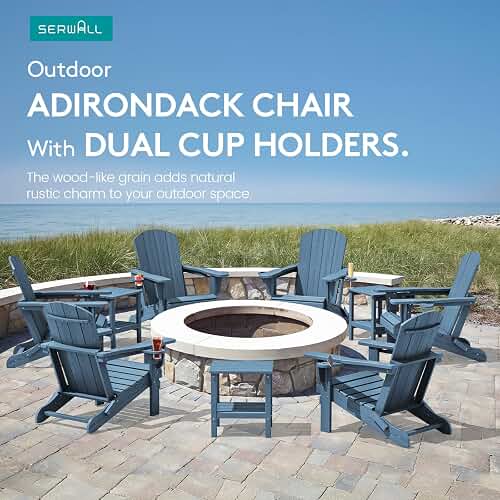
| SERWALL Outdoor Adirondack Chairs Set of 2, Blue | Check price on Amazon | 2 | 380 lbs | 32.5"D x 29.3"W x 35.8"H | Yes | 2 cup holders + phone holder | Blue |
| SERWALL Outdoor Adirondack Chairs Set of 4, Grey | Check price on Amazon | 4 | 380 lbs | 32.5"D x 29.3"W x 35.8"H | Yes | 2 cup holders + phone holder | Grey |
| GREENVINES Folding-Adirondack-Chairs Set of 2 | Check price on Amazon | 2 | 350 lbs | 30"W x 34.7"D x 35"H | Yes | Hidden arm cup holder | Blue |
| Plawdlik Folding Adirondack Chair Set of 4, Black | Check price on Amazon | 4 | 380 lbs | 33"D x 29"W x 38"H | Yes | Adjustable cup holder | Black, wood texture |
| SERWALL Outdoor Adirondack Chair Set of 2, Grey | Check price on Amazon | 2 | 380 lbs | 32.5"D x 29.3"W x 35.8"H | Yes | 2 cup holders + phone holder | Grey |
| Plawdlik HDPE Folding Adirondack Chair Set of 2, Teak | Check price on Amazon | 2 | 380 lbs | 33"D x 29"W x 38"H | Yes | Adjustable cup holder | Light teak |
Quick answer: For most people, the SERWALL Outdoor Adirondack Chairs Set of 2 with 2 Cup Holders,Foldable,Blue is the one to beat — HDPE construction, a 380 lb capacity, two cup holders and a phone slot, and it folds flat when the season ends. If you're seating a whole patio, the four-chair SERWALL or Plawdlik sets bring the per-chair cost down; if you want wood-look color without wood maintenance, the teak-finish Plawdlik pair is the cheapest entry on this list.
Adirondack chairs are one of those purchases where the differences are small on paper and enormous on your deck. Every chair below is HDPE — high-density polyethylene, the same recycled-plastic-lumber family that shows up in expensive brand-name outdoor furniture — so none of them will rot, and none of them will need sanding and re-staining every second spring. What separates them is capacity, footprint, whether they fold, how many you get, and what color you can live with looking at for a decade.
SERWALL Outdoor Adirondack Chairs Set of 2 with 2 Cup Holders — Best Overall
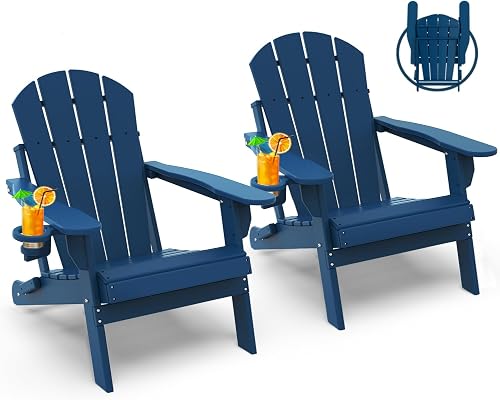
The SERWALL Outdoor Adirondack Chairs Set of 2 with 2 Cup Holders,Foldable,Blue is the default recommendation because it does not ask you to give anything up. At $189.99 for two chairs, you get virgin HDPE with a textured grain finish, a 380 lb weight capacity, reinforced joints meant to stay stable on uneven ground, and a folding frame so the pair can go in a shed over winter instead of collecting snow.
The best best adirondack chairs for your situation depends on how you plan to use it and where.
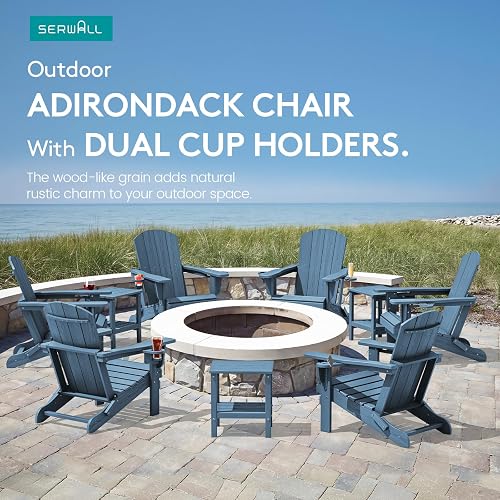
The details that actually matter day to day: two integrated cup holders per chair, plus a built-in phone holder, which is the feature you'll appreciate roughly forty times a summer. Dimensions are 32.5"D x 29.3"W x 35.8"H — genuinely oversized, with a large seat, tall backrest and wide armrests. SERWALL states the material resists denting, cracking, peeling and rotting in harsh weather, and the seat is designed to shed rainwater rather than pool it.
The blue is a real blue, not a navy pretending to be neutral. If that's not your patio, see the grey version further down — same chair, quieter color.
Skip it if: you need more than two seats, or you want a wood-tone finish.
SERWALL Outdoor Adirondack Chairs Set of 4 — Best for Seating a Whole Patio
Buying four chairs one pair at a time is how people end up with mismatched patios two summers apart. The SERWALL Outdoor Adirondack Chairs Set of 4 with 2 Cup Holders,Foldable,Grey is $389.99 for four, which works out to roughly $97.50 a chair — better math than the two-packs, and every chair arrives from the same production run in the same grey.
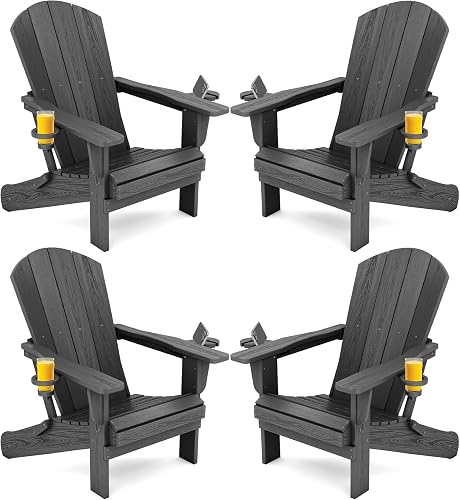
Specs match the flagship exactly: HDPE construction rated for all seasons, 380 lb capacity per chair, 32.5"D x 29.3"W x 35.8"H, two cup holders and a phone holder each, folding design for storage. Four of these at 32.5 inches deep is about 10 feet of chair if you line them up, so measure your deck before you commit — that's the actual constraint here, not the price.
Grey is the safest color on this list. It reads neutral against brick, stone, composite decking and green lawn alike.
Skip it if: you only have room for two chairs, or a fire-pit circle is your layout and you'd rather stagger purchases.
GREENVINES Folding-Adirondack-Chairs Set of 2 — Best for Small Spaces and Road Trips
The GREENVINES Folding-Adirondack-Chairs Set of 2, HDPE All Weather, Blue is the most portable pick at $189.99 for two, and the reason is weight: each chair is 36 lbs, a number GREENVINES publishes and the others don't. That's the difference between "I'll drag it over to the fire pit" and "I'll leave it where it is forever."
It folds without pins or chains — the reclined legs handle stability on their own — which means one motion to collapse it into a car trunk or against a garage wall. The cup holder is hidden in the right arm and sized for a drink or a phone. Slatted seating dries quickly after rain, and the edges are trimmed, which is a small thing that matters if kids are running past bare-legged.
Dimensions are 30"W x 34.7"D x 35"H per chair with a 350 lb capacity — the narrowest chair here and slightly lower capacity than the 380 lb sets, so it's the one to pick when patio width is tight. Assembly is partial: hardware kit and manual included, and GREENVINES says an electric screwdriver gets you there in under 20 minutes. GREENVINES describes its HDPE as waterproof, weather-resistant, fade-resistant and resistant to chipping, peeling, cracking and rotting.
Skip it if: you want the highest weight rating available, or you need seating for more than two.
Plawdlik Folding Adirondack Chair Set of 4, Black — Best Four-Chair Value
At $350.99 for four, the Plawdlik Folding Adirondack Chair Set of 4, Cup Holder,Wooden Textured ,Heavy All-Weather HDPE Comfortable Set Poolside Backyard Lawn Coffee is the cheapest way to fill four seats here — about $88 per chair. It's also the tallest and deepest option at 33"D x 29"W x 38"H, with a 104-degree recline angle Plawdlik specifies outright.
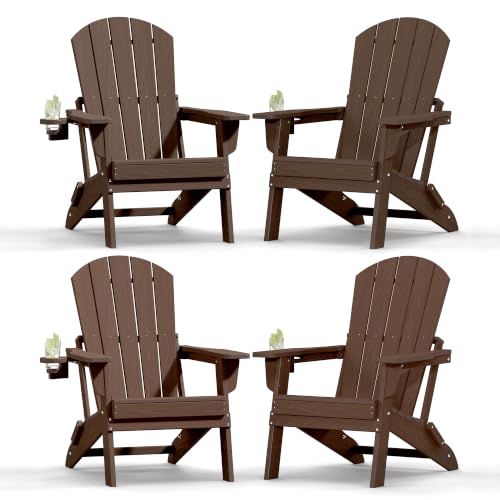
That recline number is worth pausing on. Adirondacks vary a lot in how far back they throw you, and 104 degrees is a lounging angle, not a dining angle. Combined with a 380 lb capacity and Plawdlik's note that the chairs accommodate taller and larger adults, this is the set to look at if the standard chair has ever felt like it swallowed you or spat you forward.
The surface imitates wood texture, the HDPE is compound-modified and recyclable, and Plawdlik says the seat plate has some flex to it rather than sitting rigid. Cup holders are adjustable, armrests are wider than the previous generation, and the chairs fold for storage. Plawdlik states the material handles intense sun, heavy snow, salt spray and coastal wind, cleans with a damp rag, and won't fade — worth noting if you're near the ocean. The company also cites SGS durability testing and says it supplies event chairs to U.S. consulates abroad.
Black shows dust and gets hot in direct sun. That's the trade for the price.
Skip it if: you want a lighter color, or you're seating two people and don't need four.
SERWALL Outdoor Adirondack Chair Set of 2 with Cup Holders, Grey — Best Neutral Two-Chair Set
The SERWALL Outdoor Adirondack Chair Set of 2 with Cup Holders,Grey is the flagship chair in grey, $189.99 for the pair. Everything carries over: virgin HDPE with textured grain, 380 lb capacity, 32.5"D x 29.3"W x 35.8"H, two cup holders and a phone holder, folding storage, a rainwater-shedding seat, and reinforced joints for uneven surfaces.
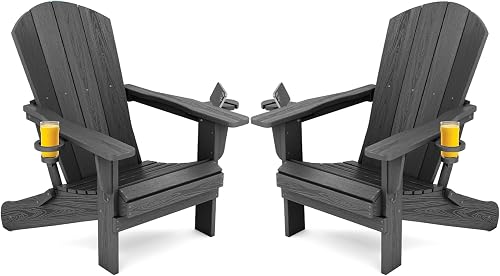
Pick this over the blue for the same reason people pick grey siding — it disagrees with nothing. It's also the natural two-chair companion if you already own or are considering the grey four-pack and want to extend the set later without a color mismatch.
Skip it if: you want a warmer, wood-look tone, or you want a bit of color on the patio.
Plawdlik HDPE Folding Adirondack Chair Set of 2, Teak — Best Wood-Look on a Budget
The Plawdlik HDPE Folding Adirondack Chair Set of 2 with Cup Holder, Teak is the lowest price here at $178.19 for two, and the only one on this list in a wood tone. Plawdlik describes it as a light teak with a brownish-yellow tint and a natural, gentle texture, and notes that lighting and screen settings will shift how it looks — a darker coffee color is offered if teak reads too light for you.
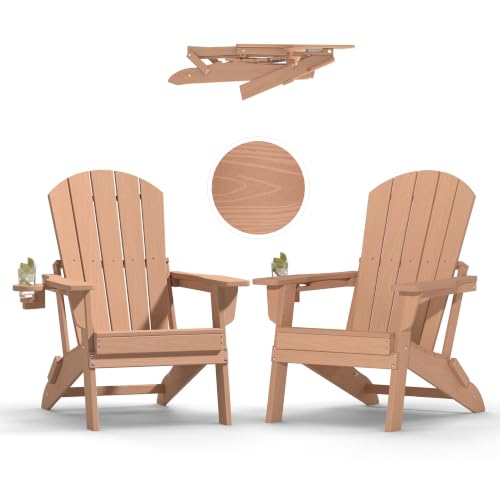
Mechanically it's the same platform as the Plawdlik four-pack: 33"D x 29"W x 38"H, 104-degree recline, 380 lb capacity, compound-modified recyclable HDPE with a wood-imitating surface, adjustable cup holders, wider armrests, folding storage, SGS durability testing, and the same claims about sun, snow, salt spray and coastal wind resistance with damp-rag cleanup.
If the appeal of an Adirondack is the cedar-cabin look but you have zero interest in annual staining, this is the shortest path to it.
Skip it if: exact color matching matters to you and you can't tolerate variation from the product photos.
Recline angle is stated only for the two Plawdlik sets (104 degrees); Not stated for the others. Per-chair weight is stated only by GREENVINES (36 lbs); Not stated elsewhere. Assembly time is stated only by GREENVINES (under 20 minutes with an electric screwdriver); Not stated elsewhere.
How to choose
HDPE is the whole point. Every chair here is high-density polyethylene rather than wood or thin injection-molded resin. HDPE is the reason these last: no rot, no repainting, no splinters. If you're cross-shopping against a cheap resin chair at half the price, that chair is not the same category of object. Don't compare on price alone.
Weight capacity separates more than you'd think. Five of these six are rated 380 lbs; the GREENVINES is 350 lbs. All of them are fine for most adults, but if you're buying for a family with a range of body sizes, or the chairs will be sat in hard by a lot of different people, the 380 lb rating gives you more margin. Plawdlik explicitly calls out taller and larger adults.
Measure before you buy — depth is the trap. These are 30 to 34.7 inches deep. Four of them across a narrow balcony will not work. Lay painter's tape on your deck at the listed dimensions before ordering, especially for a four-pack.
Folding matters if you have real winters. All six fold. What differs is how: GREENVINES specifically notes no pins or chains, which is the fastest kind to collapse. If your chairs live outside year-round in a mild climate, folding is a nice-to-have. If you're hauling them into a shed each October, it's the feature that decides whether you actually do it.
Recline angle decides comfort more than padding. The Plawdlik sets state 104 degrees. The others don't publish a number. If you specifically want a deep, lean-back lounging position — the reason most people want an Adirondack in the first place — the stated angle is useful information the other listings don't give you.
Color is a ten-year decision. HDPE color goes all the way through the material rather than sitting on top as paint, so you're picking the shade you'll live with for the life of the chair. Grey is the safe neutral, teak is the warm wood-look, black is the highest-contrast and the hottest in direct sun, blue is the one with an opinion.
Read the reviews yourself before you click buy. Check the recent reviews and the Q&A on the listing you're leaning toward — pay attention to comments about assembly hardware and any color-difference notes, since Plawdlik in particular flags that lighting and screens shift how the teak reads.
FAQ
Which is the most comfortable Adirondack chair here? Comfort in an Adirondack comes down to recline angle, seat width and armrest width. The Plawdlik sets are the only ones that publish a recline figure — 104 degrees — and Plawdlik also specifies wider armrests and a seat plate with some flex. The SERWALL chairs are described as having a large seat, tall backrest and wide armrests. Neither claim is a substitute for sitting in one, so check recent buyer reviews for comfort comments before ordering.
Is HDPE better than wood for Adirondack chairs? For low maintenance, yes, and it isn't close. HDPE doesn't rot, crack, peel or need refinishing. SERWALL states its HDPE resists denting, cracking, peeling and rotting in harsh weather. GREENVINES states its HDPE is waterproof, weather-resistant and fade-resistant. Plawdlik states its chairs handle intense sun, heavy snow, salt spray and coastal wind and clean up with a damp rag. Wood still wins on smell and patina if you enjoy the upkeep.
How much assembly should I expect? GREENVINES is the only one that gives a number: partial assembly, hardware and manual included, under 20 minutes per chair with an electric screwdriver. Plawdlik describes its chairs as easy to assemble with accurate hole positioning and a low rate of missing parts. Plan for a screwdriver and a free afternoon for a four-pack regardless.
Is a set of 4 actually cheaper per chair? Yes. The SERWALL four-pack at $389.99 works out to about $97.50 per chair versus $189.99 for two (about $95 each — close to even). The Plawdlik four-pack at $350.99 is roughly $88 per chair, the lowest per-seat cost here. The bigger argument for a four-pack isn't price, it's that all four chairs come from the same batch in the same color.
Related guides
- Yardistry Meridian vs Sunjoy Archwood Pergola
- Common Reasons Best patio and outdoor living furniture - patio sets, outdoor umbrellas, fire pits, adirondack chairs, pergolas, hammocks, gazebos, outdoor sofas, outdoor dining sets Gets Denied
- How to Succeed with Best patio and outdoor living furniture - patio sets, outdoor umbrellas, fire pits, adirondack chairs, pergolas, hammocks, gazebos, outdoor sofas, outdoor dining sets
Key Takeaways
- Choosing the right best adirondack chairs means matching the key features to your specific needs and budget
- Read real customer reviews and check the return policy before you commit
- Compare value across models — the priciest option is not always the best fit